
Tag Archives: b2b marketing Houston

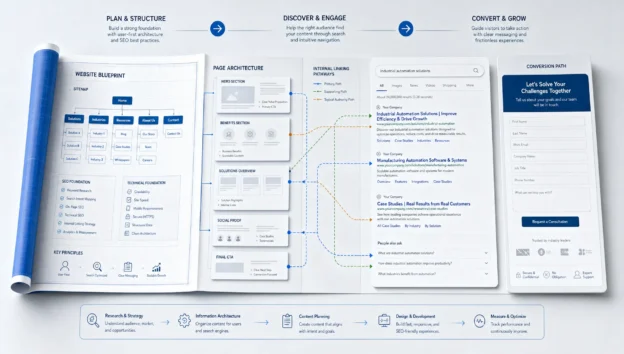
Why Web Design and Search Engine Optimisation Must Align - Main Image

Why Web Design and Search Engine Optimisation Must Align

Your website can be beautiful and still invisible. It can also rank for the right terms and still fail to generate a single qualified inquiry. That is why web design and search engine optimisation must align from the first strategy conversation, especially for B2B and industrial companies where a website often supports long sales cycles, technical evaluation, and high-value purchasing decisions.

Too often, design and SEO are treated as separate steps. A designer creates the look and experience, then an SEO specialist is asked to “optimize” the finished site. By then, the most important decisions have already been made: navigation, page structure, URL paths, copy space, internal linking, mobile behavior, and conversion flow. If those decisions ignore search behavior and buyer intent, the site may look modern but struggle to get found.

The better approach is to build for visibility, usability, and lead generation at the same time.

What alignment really means

Aligning web design and SEO does not mean sacrificing visual quality for keyword placement. It means creating a website where every major design decision supports both the visitor and the search engine.

A well-aligned site should answer four questions clearly:

  • Can search engines crawl, understand, and index the most important pages?
  • Can visitors quickly find the information they came for?
  • Does the content match the intent behind the search query?
  • Does the page make the next step obvious, whether that is requesting a quote, downloading a spec sheet, calling sales, or reviewing capabilities?

For B2B and industrial websites, this is not just a marketing preference. Buyers may search for a capability, certification, material, application, part type, location, or vendor comparison. If your site architecture and content do not reflect those real search patterns, even a polished website can miss valuable opportunities.

If you are planning a new site or a redesign, it helps to understand why web design and SEO should be planned together before wireframes, copy, and development choices become difficult to change.

Why separating design and SEO creates problems

When SEO is added late, the result is usually a compromise. The SEO team has to work around design choices that were never built for search visibility. The design team may have prioritized style, animation, or minimal copy without understanding how buyers search. The development team may have built templates that look good but limit crawlability, speed, or content depth.

Weak site architecture hides important services

Search engines rely on clear structure. So do users. If your highest-value services are buried three or four clicks deep, grouped under vague navigation labels, or combined into one broad “Solutions” page, both Google and human visitors may have trouble understanding what you actually offer.

Industrial buyers are often specific. They are not just looking for “manufacturing services.” They may search for CNC machining for aerospace parts, custom metal fabrication in Houston, industrial pump repair, or B2B chemical blending services. A generic structure can prevent those pages from earning visibility.

Thin content fails to satisfy technical buyers

Minimalist design can be effective, but it becomes a problem when pages do not provide enough useful information. A B2B buyer may need details about applications, industries served, tolerances, materials, compliance, lead times, service areas, or engineering support. Search engines also need enough context to understand the relevance of the page.

A page with a large hero image, a short paragraph, and a contact form may look clean, but it often lacks the substance needed to rank or convert.

Slow pages reduce both rankings and trust

Performance is where design, development, and SEO overlap heavily. Oversized images, unnecessary scripts, heavy animations, and unoptimized third-party tools can slow a page down. Visitors may leave before the page finishes loading, and search engines may treat poor performance as a quality signal.

This matters even more on mobile. Many B2B searches begin on phones, even if the final inquiry happens later from a desktop. If the mobile version is frustrating, your business may lose the prospect before sales ever knows they existed.

Poor conversion flow wastes qualified traffic

SEO can bring the right visitors, but design determines what happens next. If calls to action are vague, forms are hard to use, trust signals are hidden, or technical resources are difficult to find, qualified traffic will not turn into leads.

A strong website needs both discoverability and persuasion. This is why SEO and web design services drive better conversions when they are planned as one system rather than two separate deliverables.

Design decisions that affect SEO performance

Many SEO issues begin as design or development decisions. The table below shows common examples.

Design or development decision SEO impact Better approach
Vague navigation labels Search engines and users struggle to identify core services Use descriptive labels based on real buyer intent
Image-heavy pages with little text Pages lack context and relevance Balance visuals with useful, specific copy
Large uncompressed media Slower load times and weaker user experience Compress images and use modern formats where appropriate
JavaScript-dependent content Important content may be harder to crawl Ensure key content is accessible in the page HTML
Removing old URLs during a redesign Loss of rankings, links, and referral traffic Map redirects before launch
Generic calls to action Lower lead conversion rates Match CTAs to the buyer’s stage and intent

The lesson is simple: SEO is not only about keywords, and design is not only about appearance. Both shape how a website performs in the real world.

The key places where design and SEO must work together

Search intent should shape the site structure

Before a designer builds the navigation, the team should understand how prospects search. That means reviewing keyword themes, buyer questions, competitor pages, service priorities, and sales conversations.

For example, a manufacturer may need separate pages for industries served, capabilities, materials, and geographic markets. A software company may need pages for use cases, integrations, and comparison searches. A distributor may need category pages that reflect how buyers identify products, not just how the company organizes inventory internally.

Good information architecture turns search demand into a clear website structure. It also helps visitors self-select the path that fits their problem.

Page templates should allow useful content

Design systems often rely on reusable templates. That is good for consistency, but templates need enough flexibility for SEO-rich content. A service page may need sections for applications, benefits, technical specifications, FAQs, case examples, and conversion prompts. A product category page may need filters, comparison guidance, and supporting copy.

This principle applies across industries. An ecommerce brand selling custom cushions for indoor and outdoor spaces needs pages that help buyers understand options such as size, fabric, use case, and customization. A B2B industrial company has a similar challenge, even if the product is more technical: the page must organize complexity in a way that helps search engines and buyers understand the offer.

A beautiful template that leaves no room for explanation can limit organic growth. A flexible template that supports scannable, useful content gives both SEO and sales a stronger foundation.
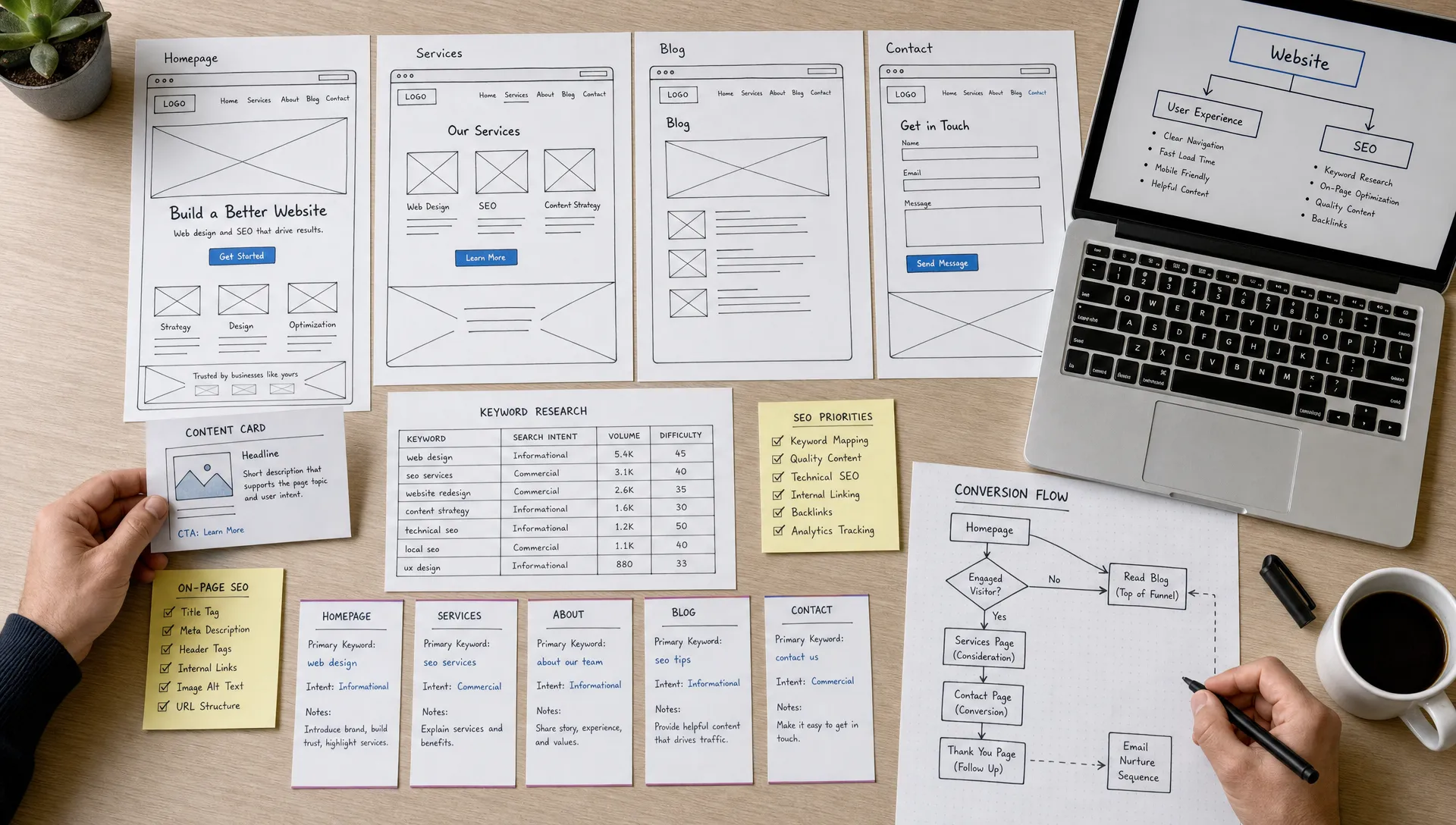
An overhead planning table with website wireframes, content cards, keyword notes, and conversion flow sketches arranged together to show web design and search engine optimisation being aligned before development.

Visual hierarchy should support decision-making

Visitors scan before they read. Strong design guides their attention to the most important information: what you offer, who it is for, why it is credible, and what to do next.

For SEO-driven pages, the visual hierarchy should make the content easy to consume. Headings should be descriptive. Sections should be clearly separated. Important details should not be hidden inside tabs that are difficult to access or elements that do not work well on mobile. Calls to action should appear at natural decision points, not only at the top or bottom of the page.

For industrial buyers, trust-building elements can be especially important. Certifications, industry experience, equipment lists, safety standards, technical documentation, and customer proof can help a visitor move from research to inquiry.

Technical performance should be designed in from the beginning

Performance is easier to protect during design than to fix after launch. A site can be visually strong without being bloated. That requires practical decisions about image sizes, font loading, scripts, hosting, caching, and mobile layouts.

Designers, developers, and SEO strategists should discuss performance before the site is built. For example, a full-width video background may look impressive, but it might not be the best choice for a service page that needs to load quickly and communicate technical value. A lighter visual treatment may deliver a better experience and better business outcome.

Content and CTAs should match the buyer journey

Not every visitor is ready to request a quote. Some are still learning, comparing options, or gathering requirements. Web design and SEO should create paths for different stages of intent.

A top-of-funnel visitor may need educational content. A mid-funnel visitor may want comparison pages, application guides, or FAQs. A bottom-of-funnel visitor may need a quote form, phone number, service area confirmation, or downloadable technical information.

When the design supports these paths, SEO traffic becomes more valuable. The website is no longer just attracting visitors. It is helping them move forward.

A practical workflow for aligning teams

The best results happen when SEO, design, content, and development collaborate early. A simple workflow can prevent many expensive problems.

Project stage SEO responsibility Design responsibility Shared goal
Discovery Identify search demand, priority pages, and technical risks Understand user needs, brand requirements, and conversion goals Define what the site must accomplish
Architecture Recommend page hierarchy, URL structure, and internal linking Create intuitive navigation and page flows Make the site easy to crawl and easy to use
Content planning Map keywords, search intent, and on-page requirements Plan layouts that support clear messaging Build pages that are useful and persuasive
Development Check crawlability, metadata, schema needs, redirects, and speed Preserve design quality across devices Launch a fast, indexable, conversion-ready site
Post-launch Monitor rankings, traffic, indexing, and conversions Refine UX based on behavior data Improve performance continuously

This workflow is especially important during redesigns. A redesign can improve a brand, but it can also damage organic visibility if URL changes, content removals, and redirects are handled carelessly.

Why alignment matters more for B2B and industrial companies

In B2B and industrial markets, a website is rarely just a brochure. It is often the first qualification step in a complex buying process. Engineers, operations managers, procurement teams, executives, and plant managers may all interact with the site for different reasons.

One visitor may search for a technical capability. Another may check whether you serve their industry. Another may look for proof that your company can handle a high-value project. If the website is designed only for visual presentation, it may not answer these questions. If it is built only for SEO traffic, it may not create enough trust to generate an inquiry.

The strongest B2B websites connect search intent to business value. They turn keyword research into pages that solve real buyer problems. They use design to make complex information understandable. They use technical SEO to protect visibility. They use conversion strategy to turn the right visits into the right leads.

That is also why search engine optimization services drive B2B leads most effectively when they are connected to the full website experience, not isolated as a traffic tactic.

Warning signs your design and SEO are out of sync

If your website is underperforming, the issue may not be traffic alone. Look for these signs:

  • Your site looks modern, but organic traffic has declined since launch.
  • Important services are grouped together on one broad page instead of having dedicated pages.
  • Visitors reach the site but rarely submit forms or call.
  • Mobile pages look attractive but load slowly or hide key content.
  • Blog posts get traffic, but service pages do not generate inquiries.
  • The design relies heavily on images, sliders, or animations while offering little crawlable text.
  • Your team cannot clearly connect each major page to a search intent and business goal.

These problems are fixable, but they are easier to prevent when strategy comes first.

Metrics that show whether alignment is working

Once design and SEO are aligned, measurement should go beyond rankings. Rankings matter, but they are only one part of performance.

Metric What it reveals
Organic traffic to priority pages Whether the right pages are gaining visibility
Qualified leads from organic search Whether traffic is converting into business opportunities
Engagement by page type Whether visitors find the content useful
Mobile performance Whether the experience works for real users across devices
Index coverage Whether search engines can access important pages
Conversion rate by landing page Whether design and messaging support action

The goal is not to chase every metric. The goal is to connect visibility, usability, and lead quality. A page that ranks but does not convert needs UX and messaging work. A page that converts well but gets little traffic may need stronger SEO. A page that gets traffic and leads is a model for future improvements.

Frequently Asked Questions

What does it mean to align web design and search engine optimisation? It means planning site structure, content, technical performance, user experience, and conversion paths together so the website can be found in search and persuade the right visitors to take action.

Should SEO be done before or after web design? SEO should begin before design. Keyword research, search intent, site architecture, URL planning, and content requirements should inform the design process rather than being added after launch.

Can a visually attractive website still perform poorly in search? Yes. A site can look excellent but struggle if it has weak content, slow load times, poor mobile usability, confusing navigation, missing metadata, or pages that do not match how buyers search.

How does web design affect B2B lead generation? Web design affects how quickly visitors understand your offer, find proof of credibility, access technical information, and take the next step. When design supports SEO intent, traffic is more likely to become qualified leads.

What should be checked before launching a redesigned website? Key checks include URL mapping, redirects, metadata, mobile performance, page speed, indexability, internal links, analytics tracking, form functionality, and whether important old content has been preserved or improved.

Bring SEO and design together before your next launch

If your website is due for a redesign, do not treat SEO as a final checklist item. Bring search strategy, content planning, design, and development into the same conversation from the beginning.

For B2B and industrial companies, that alignment can be the difference between a site that simply looks updated and a site that consistently supports visibility, trust, and lead generation. The best websites are not just designed well or optimized well. They are built as complete marketing assets, with every page serving both the buyer and the business.
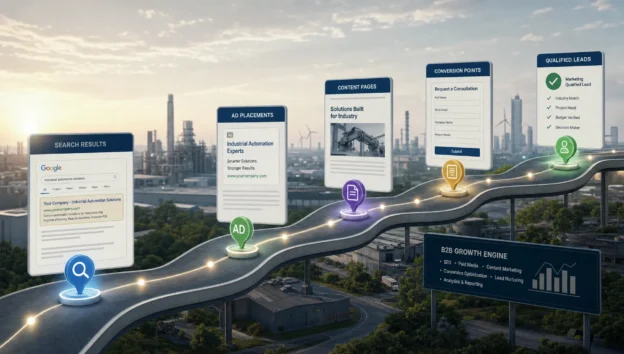
How an Online Marketing Agency Supports B2B Growth - Main Image

How an Online Marketing Agency Supports B2B Growth

B2B growth rarely comes from a single campaign, a redesigned homepage, or a few social media posts. It comes from a repeatable system that helps the right buyers find your business, understand your expertise, trust your process, and take the next step with confidence.

That is where an online marketing agency can become a growth partner instead of just a vendor. For B2B companies, especially industrial, technical, and professional service firms, digital marketing has to do more than create awareness. It must support long buying cycles, educate multiple decision-makers, and turn complex offerings into clear reasons to start a conversation.

The best agencies help connect strategy, search visibility, paid campaigns, content, web experience, and lead generation into one measurable growth engine.

Why B2B growth needs a different marketing approach

B2B buyers behave differently from consumer buyers. They research heavily, compare options quietly, involve multiple stakeholders, and often delay direct contact until they already have a shortlist. In industrial and service-based markets, a buyer may need to evaluate technical capabilities, compliance requirements, location, delivery capacity, past performance, and pricing model before requesting a proposal.

That means your marketing has to work before your sales team ever speaks to the prospect.

A B2B growth strategy must answer questions such as:

  • Can prospects find your company when they search for a specific solution?
  • Does your website explain what you do clearly enough for technical and non-technical decision-makers?
  • Are your pages built to convert visitors into inquiries, quote requests, or consultation calls?
  • Do your campaigns target buyers by intent, industry, geography, and stage of the buying process?
  • Can you measure which activities are contributing to qualified leads and revenue opportunities?

An online marketing agency supports B2B growth by building the systems behind these answers. Rather than treating SEO, PPC, content, social media, and web design as disconnected activities, the agency aligns them around the buyer journey.

The agency’s first job: clarify positioning and buyer intent

Before campaigns begin, a strong agency works to understand your market. This is especially important in B2B, where the difference between a low-quality lead and a serious opportunity can be significant.

For example, a manufacturer, engineering firm, distributor, or industrial service provider may serve a narrow set of buyers with very specific problems. Ranking for broad keywords might generate traffic, but it may not generate sales-ready inquiries. The better opportunity is often found in high-intent searches that describe the application, location, problem, equipment type, compliance requirement, or service need.

This is why strategy comes before execution. An agency should help identify:

  • Your most profitable customer segments
  • The problems buyers are trying to solve
  • The phrases prospects use when researching solutions
  • The objections that prevent them from contacting sales
  • The content gaps between awareness and decision
  • The conversion points that make sense for your sales cycle

This foundation helps marketing support growth with precision. If you want a deeper look at visibility as the starting point, the article on whether your business is visible on the web explains why discoverability matters for B2B buyers before they contact a supplier or service provider.

How an online marketing agency supports the B2B growth system

A growth-focused agency does not simply bring more visitors to your website. It improves the full path from search to sale. Each marketing channel has a role, and each role should connect to a business outcome.

Growth area What the agency supports Why it matters for B2B
Market positioning Messaging, audience definition, value proposition, offer clarity Helps buyers quickly understand why your company is relevant
SEO Technical optimization, keyword strategy, content planning, on-page improvements Captures demand from prospects actively researching solutions
PPC Search ads, campaign targeting, landing pages, budget management Generates faster visibility for high-intent searches and priority markets
Content marketing Blog posts, service pages, case-style content, FAQs, educational resources Builds trust and supports long decision cycles
Website experience Page structure, calls to action, mobile usability, conversion paths Turns visitors into leads instead of losing them to confusion
Social and video marketing Distribution, credibility building, search-friendly media assets Expands reach and reinforces expertise across channels
Reporting Lead tracking, campaign performance, search visibility, conversion analysis Shows what is working and where to improve

For B2B companies, the most important word in that table is “system.” Growth becomes more predictable when every channel reinforces the others.

Search visibility turns buyer research into opportunity

Most B2B buyers begin with research. They may not search for your company name at first. They search for the problem, category, service, equipment, specification, or local provider they need.

Search engine optimization helps your business appear during that research process. A capable agency will usually look at technical SEO, site structure, service page quality, content depth, internal linking, local relevance, and the quality of calls to action. For B2B companies, SEO also means matching content to intent.

A buyer searching “industrial pump repair Houston” is much closer to action than someone searching “how pumps work.” Both may matter, but they should not be treated the same. The first search may need a service page, proof of capability, and a quote request. The second may need educational content that introduces expertise earlier in the journey.

This is why SEO for B2B should be tied to lead generation, not vanity traffic. The goal is to attract the right visitor and guide that person toward a useful next step. For more on that connection, see how search engine optimization services drive B2B leads through intent-focused content and conversion planning.

PPC helps B2B companies compete where timing matters

SEO builds durable visibility, but it takes time. Pay-per-click advertising can help B2B companies reach buyers faster, especially when entering a new market, promoting a priority service, or competing for high-value search terms.

For B2B, PPC should be managed carefully because clicks can be expensive and broad targeting can waste budget. An online marketing agency can support growth by refining keyword match types, excluding irrelevant searches, testing landing pages, tracking conversions, and adjusting spend based on lead quality.

Good PPC management also considers the buying stage. Some campaigns may target urgent service needs. Others may promote downloadable resources, consultation requests, or quote forms. The campaign structure should reflect the real sales process, not just the desire for more clicks.

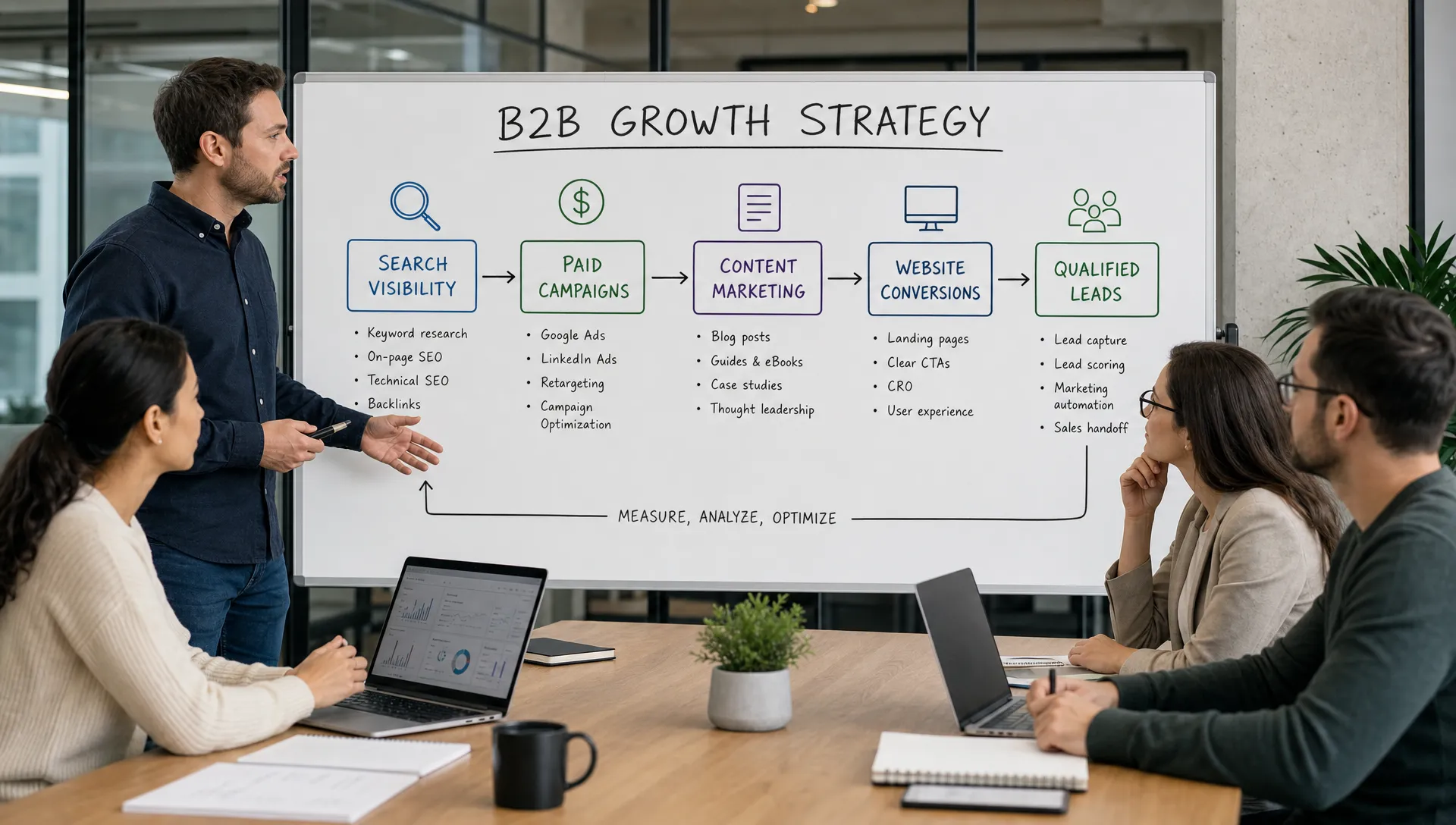
A B2B marketing team reviews a growth strategy board showing search visibility, paid campaigns, content, website conversions, and qualified leads connected in a simple workflow, in a modern office setting with the board facing the camera and the team positioned around it.

Content builds trust before the sales conversation

In B2B markets, trust is often built through education. Buyers want to know whether your company understands their industry, their risks, their terminology, and their decision criteria. Content gives your business a way to demonstrate that expertise before a prospect fills out a form.

An agency can help turn internal knowledge into useful public-facing assets. This might include service pages, comparison articles, technical explainers, industry-specific blog posts, FAQ sections, landing page copy, and video-friendly content. The key is to write for real buyers, not just search engines.

Effective B2B content usually does one or more of the following:

  • Explains a complex service in plain language
  • Helps buyers evaluate options or requirements
  • Answers common sales questions before a call
  • Shows industry familiarity and credibility
  • Supports SEO by targeting relevant search intent
  • Gives sales teams useful material to share with prospects

This is where inbound marketing becomes especially valuable. Instead of interrupting buyers who may not be ready, inbound content attracts people already trying to solve a problem. If your team is building that foundation, this overview of inbound marketing online explains how SEO, content, and digital channels work together to attract targeted audiences.

Website design and conversion paths turn attention into leads

A website can generate traffic and still fail as a growth tool. If visitors cannot quickly understand your services, industries, location, credibility, or next step, they may leave without contacting you.

For B2B companies, website conversion does not always mean an immediate purchase. It might mean a consultation request, RFQ submission, phone call, contact form, downloadable resource, or proposal enquiry. The conversion path should match how buyers prefer to engage.

An online marketing agency can support better conversion by improving page hierarchy, calls to action, form placement, mobile responsiveness, trust signals, service page copy, and navigation. For industrial and technical companies, clarity is especially important. A buyer should not have to guess whether you serve their market or solve their problem.

Strong B2B web pages typically include:

  • A clear explanation of the service or solution
  • Industries or applications served
  • Specific problems addressed
  • Proof points such as experience, capabilities, or results when available
  • Practical next steps such as request a quote, schedule a consultation, or contact the team

The goal is not to make every page aggressive. The goal is to make every page useful and purposeful.

Lead quality improves when marketing and sales share feedback

B2B growth depends on lead quality, not just lead volume. A campaign that produces many unqualified inquiries can waste sales time. A campaign that produces fewer but better-fit opportunities may be far more valuable.

This is why an agency should pay attention to feedback from sales teams. Which leads became serious conversations? Which keywords produced poor-fit inquiries? Which landing pages attracted the right industries? Which questions came up repeatedly during sales calls?

When sales feedback informs marketing, campaigns improve over time. SEO content becomes more relevant. PPC budgets shift toward stronger terms. Website copy addresses real objections. Calls to action become more aligned with buyer readiness.

This feedback loop is one of the most overlooked advantages of working with an agency that understands B2B markets. Growth is not just launched. It is refined.

Compliance and trust are part of modern B2B marketing

As digital marketing becomes more data-driven, B2B companies must also consider privacy, governance, and responsible lead handling. Contact forms, analytics tools, email campaigns, advertising pixels, and customer data all create obligations that should not be ignored.

An online marketing agency can help coordinate marketing practices with your internal policies, but companies may also need specialized support for privacy and compliance requirements. Organizations operating across regulated markets can benefit from external governance, risk, and compliance guidance to ensure that marketing growth does not create unnecessary data protection risk.

Trust is a growth factor. Buyers want to work with companies that handle information professionally, communicate clearly, and operate responsibly.

The metrics that show whether B2B marketing is working

B2B marketing performance should be measured across the full funnel. Traffic matters, but it is only one signal. Rankings matter, but they are not the final business outcome. Leads matter, but only if they are qualified.

A good agency helps define the right metrics based on your goals, sales cycle, and available tracking.

Metric What it reveals Why it supports growth decisions
Organic visibility Whether your business appears for relevant searches Shows if SEO is expanding your reach with target buyers
Paid search conversion rate How well ads and landing pages turn clicks into inquiries Helps improve budget efficiency
Lead source Where inquiries originate Shows which channels contribute to pipeline
Form and call conversions How visitors take action Identifies website performance issues and opportunities
Content engagement Which pages attract and assist buyers Guides future content planning
Lead quality feedback Whether inquiries match sales criteria Keeps campaigns focused on revenue potential
Cost per qualified lead What it costs to generate a viable opportunity Supports smarter budget allocation

For many B2B companies, the most valuable reporting combines marketing data with sales context. If a report shows traffic growth but no improvement in inquiry quality, the strategy needs adjustment. If paid search produces fewer leads but stronger opportunities, the campaign may be doing its job.

What to look for in an online marketing agency for B2B growth

The right agency should understand that B2B marketing is not the same as e-commerce, local consumer marketing, or brand awareness alone. You want a partner that can think strategically, execute consistently, and communicate in business terms.

Look for an agency that can:

  • Connect SEO, PPC, content, and website improvements to lead generation goals
  • Understand technical or service-based buying processes
  • Build campaigns around buyer intent instead of generic traffic
  • Explain reporting clearly and honestly
  • Collaborate with sales teams to improve lead quality
  • Recommend practical next steps based on data
  • Balance short-term campaigns with long-term organic growth

It is also important to set realistic expectations. B2B growth takes time because trust, rankings, content authority, and sales pipeline all develop over months, not days. PPC can create faster visibility, but even paid campaigns need testing and refinement. SEO and inbound marketing build compounding value, but they require patience and consistency.

How B2B growth compounds over time

The strongest benefit of working with an online marketing agency is not one campaign. It is the compounding effect of coordinated improvements.

A better service page can improve SEO rankings, increase PPC conversion rates, support sales conversations, and reduce confusion for buyers. A helpful blog post can attract early-stage prospects, answer common questions, and internally link to a high-intent service page. A well-managed paid campaign can reveal keyword data that informs SEO strategy. A website redesign can increase the value of every visitor from every channel.

That is how digital marketing becomes a growth asset. Each improvement makes the next one more effective.

For B2B companies in competitive markets such as Houston, this matters. Buyers have more options, more information, and less patience for unclear messaging. A structured online marketing approach helps your business stay visible, credible, and ready when prospects begin searching.

Frequently Asked Questions

How does an online marketing agency help B2B companies grow? An online marketing agency helps B2B companies grow by improving search visibility, managing paid campaigns, creating useful content, strengthening website conversions, and tracking which channels generate qualified leads.

Is SEO or PPC better for B2B growth? Both can be valuable. SEO builds long-term visibility and authority, while PPC can generate faster traffic for high-intent searches. Many B2B companies benefit from using both together, with PPC providing immediate data and SEO building compounding value.

How long does B2B online marketing take to show results? Timelines vary by market, competition, website condition, budget, and sales cycle. PPC can often produce earlier signals, while SEO and inbound marketing typically require consistent work over several months to build stronger visibility and lead flow.

What makes B2B marketing different from B2C marketing? B2B marketing usually involves longer sales cycles, higher-value decisions, multiple stakeholders, technical evaluation, and a greater need for trust-building content. The strategy must focus on qualified opportunities, not just broad reach.

What should a B2B company prepare before hiring an agency? It helps to prepare information about your ideal customers, priority services, sales process, common buyer questions, competitive advantages, current website performance, and lead quality goals.

Build a more predictable B2B growth engine

An online marketing agency supports B2B growth by connecting strategy with execution. The value is not simply more traffic. The value is better visibility, clearer messaging, stronger conversion paths, and a marketing system that helps the right buyers take action.

If your company needs support with SEO, PPC, inbound marketing strategy, social media marketing, video SEO, web content, or website improvements, B2B Inbound Marketing can help you focus your digital efforts around visibility and lead generation. Start by reviewing your current online presence, then identify the gaps that are keeping qualified buyers from finding and contacting your business.

SEO Houston for B2B Companies: What Matters Most - Main Image

SEO Houston for B2B Companies: What Matters Most

For B2B companies in Houston, SEO is not just a traffic channel. It is a way to be visible when engineers, procurement teams, operations managers, founders, and executives are researching a problem long before they speak with sales.

That matters because B2B buying cycles are rarely simple. A prospect may start with a broad question, compare vendors weeks later, involve multiple stakeholders, and only then request a quote or consultation. Good SEO helps your company show up at each of those moments with the right page, the right message, and a clear next step.

The challenge is that “SEO Houston” can mean very different things depending on the business. A local professional services firm, industrial manufacturer, SaaS provider, distributor, and engineering company do not need the same SEO plan. What matters most is building a search strategy around buyer intent, technical performance, content quality, local relevance, and measurable lead generation.

Why B2B SEO in Houston is different

Houston is a competitive B2B market with strong concentrations in energy, manufacturing, logistics, industrial services, construction, technology, healthcare, and professional services. Many companies are not selling impulse purchases. They are selling high-consideration solutions that require trust, proof, and repeated exposure.

That changes how SEO should be planned. A B2B company should not judge SEO success only by total traffic. A small increase in qualified visits from the right audience can be more valuable than thousands of low-intent visits from people who will never buy.

B2B search behavior also tends to be more specific. Buyers search for problems, specifications, certifications, comparisons, service areas, integration needs, compliance questions, cost drivers, and implementation concerns. Your SEO strategy should reflect those real questions, not just generic high-volume keywords.

Google’s own guidance emphasizes creating helpful, reliable, people-first content. In B2B, that means content that demonstrates real expertise, answers practical buyer questions, and makes it easy for a serious prospect to understand whether your company is a fit.

What matters most for SEO Houston campaigns

A strong B2B SEO campaign has many moving parts, but some factors consistently matter more than others. If your company has limited time or budget, prioritize the fundamentals that directly influence discoverability, credibility, and lead quality.

1. Search intent before keyword volume

Keyword research is still important, but keyword volume can be misleading in B2B. Many profitable terms have low search volume because they are highly specialized. A term with 30 searches per month may be more valuable than a broad keyword with 3,000 searches if it attracts decision-makers close to buying.

Instead of asking, “Which keyword has the most searches?” ask, “What is the buyer trying to accomplish?”

Common B2B search intent categories include:

  • Problem awareness: The buyer is trying to understand a challenge, such as production downtime, lead quality, software integration, or compliance risk.
  • Solution research: The buyer is comparing possible approaches, such as SEO vs. PPC, managed services vs. in-house teams, or custom manufacturing vs. off-the-shelf parts.
  • Vendor evaluation: The buyer is looking for providers, case studies, certifications, locations, pricing factors, or proof of experience.
  • Implementation support: The buyer wants checklists, specifications, best practices, or troubleshooting guidance.

When your content aligns with these stages, SEO becomes more than rankings. It becomes part of your sales process.

2. Technical SEO that lets Google and buyers access your site

Technical SEO is not glamorous, but it is essential. If search engines cannot crawl, index, and understand your website, even strong content can underperform.

For B2B companies, technical SEO should focus on speed, mobile usability, crawlability, secure browsing, clean site architecture, and structured data where appropriate. According to Google Search Central, search-friendly sites make it easier for Google to discover content and for users to navigate it.

A practical technical SEO review should look at:

  • Whether important service pages are indexable
  • Whether page titles and meta descriptions accurately describe each page
  • Whether navigation helps users find services, industries, resources, and contact options
  • Whether slow pages are hurting engagement and conversions
  • Whether duplicate or thin pages are diluting search relevance

Technical SEO also supports conversion. A fast, clear, easy-to-use website gives prospects confidence. A slow or confusing website can quietly reduce lead volume, even if rankings improve.

3. Local relevance without limiting your market

Many Houston B2B companies serve both local and national markets. That creates a strategic question: should SEO focus on Houston, the broader region, or industry-specific visibility across the country?

The answer depends on how buyers select vendors. If location matters because of service response times, local relationships, site visits, logistics, or regional expertise, Houston-focused SEO should be prominent. If your company sells nationally, local SEO should still support credibility but not restrict the entire content strategy.

For Houston SEO, the basics include accurate business information, location-relevant service pages, locally relevant content, consistent citations, and a well-maintained Google Business Profile where applicable. However, avoid creating thin city pages just to target every suburb. Strong local content should explain why your location benefits the buyer.

For example, a Houston industrial services company might discuss response times across the Gulf Coast, experience with petrochemical facilities, or knowledge of regional operating conditions. That is more persuasive than repeating “Houston” on a generic service page.

4. Content that proves expertise, not just visibility

B2B buyers are skeptical. They do not want vague marketing copy. They want evidence that you understand their industry, their constraints, and the cost of getting the decision wrong.

That is why the best B2B SEO content often includes use cases, comparison guides, technical explanations, FAQs, industry-specific landing pages, and case studies. Your website should answer the questions sales teams hear every week.

For example, a strong content plan may include pages such as:

  • Service pages that clearly describe who the service is for and what problems it solves
  • Industry pages for priority sectors, such as manufacturing, energy, SaaS, logistics, or professional services
  • Educational articles that explain how to evaluate solutions
  • Conversion pages built around consultations, audits, RFQs, or proposal requests
  • Proof pages featuring examples, results, certifications, or client types when available

If you want a deeper look at how SEO supports lead generation, this guide on how search engine optimization services drive B2B leads explains how intent, content, and conversion paths work together.

A practical SEO priority map for B2B companies

The best SEO strategies do not treat every page the same. Each page should have a job. Some pages attract early-stage researchers, while others convert prospects into leads.

Buyer stage What the buyer needs SEO content that helps Business goal
Awareness Understand the problem Educational blog posts, guides, FAQs Build visibility and trust
Consideration Compare approaches Service explainers, comparison content, industry pages Shape the buyer’s criteria
Evaluation Choose a provider Case studies, testimonials, proposal pages, contact pages Generate qualified leads
Decision support Justify the choice internally ROI pages, checklists, implementation resources Help sales close opportunities

This is where many B2B SEO campaigns fall short. They publish blog posts but neglect the pages that actually convert. Or they optimize service pages but never create content that helps buyers earlier in the journey. The strongest approach connects all stages.

A Houston B2B marketing team reviewing search intent, website performance, and lead quality metrics around a conference table with notes, charts, and laptops facing them, in a modern office meeting room.

Conversion matters as much as rankings

Ranking on Google is only valuable if the right visitors take action. For B2B companies, conversion does not always mean an immediate purchase. It may mean requesting a proposal, booking a consultation, downloading a guide, calling the office, or submitting an RFQ.

Your website should make those actions obvious and low-friction. Each important page should answer three questions quickly: who you help, what problem you solve, and what the visitor should do next.

Strong conversion elements include clear calls to action, short forms, visible phone numbers, trust signals, relevant proof, and copy that speaks to the buyer’s industry. For complex B2B offers, it can also help to include qualifying details such as service areas, project types, minimum fit criteria, or typical engagement models, as long as they are accurate.

SEO and conversion rate optimization should not be separated. A page can rank well and still fail if it does not persuade. If your site attracts traffic but does not produce enough inquiries, the issue may be messaging, layout, form friction, or offer clarity. This is why website optimization services that improve conversion rates are often a key part of an SEO plan.

Authority is built through relevance and trust

Backlinks still matter, but B2B companies should think beyond link quantity. A relevant mention from an industry publication, association, vendor, customer, partner, or local business organization can be more meaningful than dozens of low-quality directory links.

Authority also comes from the people behind the business. Subject matter experts, leadership perspectives, technical insights, and real-world experience all help strengthen credibility. Search engines and buyers are both looking for signals that your company is legitimate, knowledgeable, and active in its market.

For companies growing into new regions or building stronger go-to-market teams, SEO also depends on having the right people in sales, marketing, client service, and leadership roles. In some cases, working with specialist executive search partners for sales and marketing leadership can support the broader growth engine that turns search visibility into revenue.

The key is alignment. SEO should not operate in isolation from sales, hiring, product, operations, or customer service. The best content often comes from real conversations with prospects, customers, and internal experts.

Common mistakes B2B companies make with SEO

Many B2B companies invest in SEO but do not get the results they expect. Often, the problem is not that SEO does not work. The problem is that the strategy is too generic.

One common mistake is targeting broad keywords that attract unqualified visitors. A Houston company may rank for general informational terms but fail to attract decision-makers in its target industries. Another mistake is publishing content without a clear conversion path. If a visitor reads an article and has no obvious next step, the opportunity may be lost.

Other frequent issues include neglecting technical SEO, ignoring local search signals, using thin service pages, failing to update outdated content, and measuring success only by rankings. Rankings are useful, but they are not the full story.

A mature B2B SEO program should connect search performance to business outcomes. That means tracking not only impressions and clicks, but also inquiries, lead quality, sales conversations, and pipeline influence.

How to measure what matters most

SEO measurement should be simple enough to guide decisions but detailed enough to reveal what is actually working. For B2B companies, the most important metrics usually sit between marketing activity and sales outcomes.

Metric Why it matters What to watch
Organic impressions Shows whether visibility is growing Growth for relevant non-branded searches
Organic clicks Shows whether searchers choose your result Click-through rate and page relevance
Qualified traffic Shows whether the right people are visiting Industry, geography, landing pages, engagement
Conversions Shows whether SEO creates action Forms, calls, RFQs, consultations, downloads
Lead quality Shows whether traffic matches sales needs MQLs, SQLs, close rates, deal size
Pipeline influence Shows revenue impact Opportunities sourced or assisted by organic search

Google Search Console can help you understand search queries and page visibility. Analytics tools can show engagement and conversions. Your CRM should connect leads back to sales outcomes wherever possible.

Do not expect every valuable SEO touchpoint to be the final conversion source. In B2B, organic search often assists the journey by educating prospects, supporting vendor evaluation, and reinforcing credibility before a lead is submitted.

Choosing the right SEO approach in Houston

The right SEO approach depends on your business model, sales cycle, target industries, and internal resources. A small professional services firm may need a focused local SEO and content strategy. An industrial supplier may need technical service pages, product category optimization, and industry-specific content. A SaaS company may need scalable topic clusters, comparison pages, and conversion-focused landing pages.

Before investing in SEO, clarify these points:

  • Which industries, accounts, or buyer roles matter most?
  • Which services or solutions are most profitable?
  • Which geographic markets should SEO support?
  • What questions do prospects ask before they contact sales?
  • What counts as a qualified lead?
  • How will marketing and sales follow up with inbound inquiries?

If you are comparing agencies or consultants, look for a partner that understands business goals, not just keywords. This article on how to choose the best search engine optimization companies covers practical criteria for evaluating fit, strategy, and credibility.

Frequently Asked Questions

What makes SEO for B2B companies different from B2C SEO? B2B SEO usually involves longer buying cycles, multiple decision-makers, more specialized search terms, and a stronger need for proof. The goal is not just more traffic, but more qualified leads and better sales conversations.

Is local SEO important for Houston B2B companies? Yes, if location affects trust, service delivery, response time, or vendor selection. Even companies serving national markets can benefit from Houston-specific credibility, especially when local relationships matter.

How long does B2B SEO take to work? SEO is typically a long-term channel. Some technical and on-page improvements can help sooner, but meaningful growth often takes several months of consistent work, especially in competitive markets.

Should B2B companies invest in SEO or PPC first? It depends on your goals. PPC can create faster visibility, while SEO builds durable organic presence over time. Many B2B companies use both, with PPC supporting immediate demand and SEO building long-term lead generation.

What is the most important SEO metric for a B2B company? Qualified leads and pipeline influence matter more than raw traffic. Rankings and clicks are useful indicators, but the real test is whether SEO attracts prospects that match your target customer profile.

Ready to make SEO work harder for your B2B pipeline?

For Houston B2B companies, SEO works best when it is tied to buyer intent, technical strength, expert content, conversion strategy, and measurable business outcomes. Rankings matter, but qualified opportunities matter more.

If your company needs help improving search visibility, generating better leads, or connecting SEO with inbound marketing, PPC, web content, and website optimization, Andy Alagappan’s B2B Inbound Marketing can help you build a practical strategy around your market and goals.

Website Optimization Services That Improve Conversion Rates - Main Image

Website Optimization Services That Improve Conversion Rates

More traffic is valuable only when the website is built to turn that traffic into opportunities. For many B2B and industrial companies, the real problem is not a lack of visitors. It is that the right visitors land on the site, browse for a few seconds, and leave without requesting a quote, booking a consultation, or contacting sales.

That is where website optimization services become different from basic web maintenance. Optimization is not just fixing broken links or refreshing a homepage banner. It is a structured process that improves visibility, user experience, page performance, messaging, and conversion paths so more visitors take the next step.

For Houston-area B2B companies, manufacturers, distributors, SaaS firms, and professional service providers, a conversion-focused website can support a longer sales cycle, educate multiple stakeholders, and generate qualified leads around the clock.

What website optimization services actually include

Website optimization is often misunderstood as a purely technical service. Speed, mobile performance, and code quality matter, but they are only part of the picture. A website can load quickly and still fail to convert if the offer is unclear, the navigation is confusing, or the contact form feels like work.

The most effective website optimization services connect three areas:

  • Search visibility so the right buyers can find the site.
  • User experience so visitors can understand the company and move through the site easily.
  • Conversion strategy so each important page encourages a measurable business action.

In practical terms, this may include technical SEO, landing page improvements, conversion rate optimization, analytics setup, mobile usability, content refinement, call-to-action updates, form optimization, and page speed improvements.

If your business already invests in SEO or PPC, optimization becomes even more important. Paid and organic traffic are expensive to earn. Every weak landing page, vague service description, or confusing form reduces the return from that investment.

Why conversion rate should guide website decisions

A website should not be judged only by sessions, rankings, or impressions. Those numbers matter, but they do not tell the full story. A B2B company can rank for valuable keywords and still lose revenue if visitors do not understand what to do next.

Conversion rate optimization, often called CRO, focuses on improving the percentage of visitors who complete a desired action. That action might be submitting an RFQ, calling a sales team, downloading a technical guide, requesting a demo, or filling out a proposal form. For a deeper introduction to the business value of CRO, see this overview of the importance and benefits of implementing conversion rate optimization.

The goal is not to pressure every visitor into an immediate sale. In B2B markets, buyers often compare vendors, gather specifications, involve purchasing teams, and return multiple times before contacting sales. A well-optimized website supports that process by answering questions clearly and reducing friction at every stage.

Core website optimization services that improve conversions

Technical performance and page speed

Slow websites lose attention fast. Page speed affects user experience, paid campaign performance, and organic search visibility. Google also uses Core Web Vitals to evaluate aspects of real-world page experience, including loading performance, interactivity, and visual stability, as explained in Google Search Central's Core Web Vitals documentation.

For conversion-focused optimization, technical work often includes compressing images, improving server response time, cleaning up unused scripts, reducing layout shifts, and making pages easier to crawl. These changes are not just technical wins. They help visitors reach key content without delay.

This is especially important for mobile users. Even in industrial and B2B sectors, buyers may first research vendors from a phone while traveling, attending a job site, or checking options between meetings. If the mobile experience is slow or hard to navigate, the lead may never return on desktop.

Search intent and content alignment

SEO brings visitors to the website, but the page must match what the searcher expected to find. Someone searching for industrial pump repair, B2B inbound marketing, custom fabrication, or SaaS implementation help is usually looking for a specific answer. If the landing page gives a generic company overview instead, the visitor may bounce.

Strong website optimization services review keyword intent, page structure, internal linking, headings, and calls to action. The question is simple: does each page satisfy the reason the visitor came?

For B2B companies, this often means creating or improving pages for specific industries, services, technical applications, buyer problems, and geographic markets. If lead generation is the goal, your SEO strategy should connect visibility to buyer intent, as explained in this article on how search engine optimization services drive B2B leads.

Landing page and message clarity

A visitor should understand what you do, who you help, and why you are credible within seconds. Many low-converting websites bury the value proposition under vague language such as solutions for your business or quality service you can trust. Those phrases do not explain enough.

Conversion-focused landing pages usually need:

  • A clear headline tied to the visitor's problem.
  • Supporting copy that explains the service in plain language.
  • Proof points such as certifications, project types, industries served, or testimonials.
  • Calls to action that match the visitor's stage of research.
  • Visuals that clarify the offer rather than decorate the page.

For example, a business selling technical or customized products should make product categories, specifications, ordering steps, turnaround expectations, and contact options easy to find. A site offering custom woven labels and patches shows why product clarity matters, because visitors often need to compare materials, formats, and use cases before they are ready to request or place an order.

The same principle applies to industrial service providers. If a maintenance manager needs emergency repair, the page should prioritize response time and contact options. If an engineering team is evaluating a long-term vendor, the page should provide capabilities, standards, case evidence, and technical depth.

High-impact optimization areas at a glance

Optimization area Why it affects conversion rate Common improvements Useful metrics
Page speed Visitors leave when pages feel slow or unstable Image compression, script cleanup, hosting improvements Load time, Core Web Vitals, bounce rate
Landing page copy Buyers need to quickly understand fit and value Clear headlines, stronger service descriptions, better proof points Engagement rate, form submissions, scroll depth
Calls to action Visitors need an obvious next step Better CTA text, improved placement, stage-based offers Click-through rate, lead rate
Forms Long or confusing forms create friction Fewer unnecessary fields, clearer labels, better mobile layout Form completion rate, abandonment rate
Mobile experience Many visitors research from phones or tablets Responsive design, readable text, tap-friendly buttons Mobile conversion rate, mobile engagement
Analytics Teams need reliable data to improve decisions Event tracking, goal setup, CRM source tracking Conversion rate, cost per lead, lead quality

A B2B marketing team reviews a website performance dashboard and landing page wireframes on a conference table, with charts showing visitor flow, lead forms, and conversion metrics.

Form optimization and lead capture

Forms are one of the most common places where leads are lost. A visitor may be interested, but if the form asks for too much too soon, has unclear fields, fails on mobile, or does not explain what happens after submission, conversion rates suffer.

In B2B, form strategy should match the value of the offer. A contact form for a sales conversation can ask for company name, email, phone number, and project details. A top-of-funnel guide or checklist should usually ask for less. The more effort you require, the more value you need to provide in return.

It also helps to add reassurance near forms. Simple details such as response time, who will follow up, or what information the sales team needs can reduce hesitation. For industrial buyers, a short note such as include pressure range, material type, application, or required delivery date may improve lead quality without making the form feel longer.

If your site is getting traffic but inquiries are declining, the issue may not be the market. It may be that the website is creating friction. This is one of the problems discussed in the article on why a website may be losing leads.

Trust signals that help B2B visitors take action

B2B visitors are risk-aware. They are not only asking whether you offer a service. They are asking whether your company can be trusted with a budget, deadline, compliance requirement, or operational problem.

Trust signals reduce that perceived risk. Depending on the business, these may include industry experience, certifications, safety records, client logos, testimonials, case studies, before-and-after examples, technical documentation, media mentions, or leadership credentials.

The key is relevance. A generic testimonial is less persuasive than proof tied to a specific problem or industry. A manufacturing company may benefit from showing equipment capabilities, quality processes, tolerances, and delivery experience. A B2B marketing agency may benefit from showing strategy, campaign structure, channel expertise, and measurable lead outcomes.

Trust also comes from consistency. If your ads promise one thing, your landing page says another, and your contact form leads to a vague thank-you page, confidence drops. Website optimization should make the entire path feel connected.

Analytics and testing turn opinions into decisions

Many website redesigns fail because decisions are based on preferences rather than evidence. One person likes a certain homepage layout. Another prefers a different call-to-action color. A third wants more copy above the fold. Without data, these debates can go in circles.

Optimization services should include measurement. At minimum, a business should know where leads come from, which pages assist conversions, which forms perform best, and where visitors exit. More advanced tracking can connect website behavior to CRM stages, revenue, or lead quality.

Testing does not always mean large, complex A/B testing programs. For many B2B websites, the first improvements come from fixing obvious friction. After that, controlled tests can compare headlines, CTA language, page layouts, form length, and offer types.

The strongest optimization programs combine qualitative and quantitative insight. Analytics show what is happening. Sales conversations, customer questions, heatmaps, and user feedback help explain why it is happening.

How website optimization supports SEO and PPC ROI

SEO and PPC are often treated as traffic channels, but their profitability depends heavily on the website experience after the click. If a paid search campaign sends buyers to a weak page, cost per lead rises. If an SEO page ranks well but lacks a clear next step, organic traffic becomes underused potential.

Website optimization improves marketing ROI by increasing the value of existing traffic. For example, if a landing page receives 2,000 monthly visits and converts at 1 percent, it produces 20 leads. Improving that rate to 2 percent doubles leads from the same traffic volume. That can be more efficient than doubling ad spend or waiting months for additional rankings.

For B2B companies with long sales cycles, the benefits can extend beyond the initial form submission. Better educational content can improve lead quality. Clearer service pages can reduce unqualified inquiries. Stronger trust signals can shorten early sales conversations. Better tracking can show which campaigns deserve more investment.

Signs your business needs website optimization services

Not every website needs a full redesign. Sometimes focused optimization is enough. Your company may benefit from professional optimization if you notice these issues:

  • Traffic is increasing, but leads are flat or declining.
  • PPC campaigns generate clicks but few qualified inquiries.
  • Important service pages have high bounce rates.
  • Mobile visitors convert far worse than desktop visitors.
  • Sales teams say leads are confused about services or pricing factors.
  • Forms receive spam, incomplete submissions, or low-quality inquiries.
  • The website looks professional but does not clearly explain value.

These symptoms often point to a mismatch between traffic, messaging, user experience, and conversion paths. Optimization helps identify where that mismatch occurs and what to improve first.

Choosing the right website optimization partner

The right partner should understand that conversion rate improvement is not one tactic. It is a combination of marketing strategy, technical execution, content quality, and measurement.

When evaluating website optimization services, ask how the provider diagnoses problems before recommending changes. A credible process should include analytics review, SEO review, page experience analysis, content evaluation, conversion path mapping, and discussion with your sales or leadership team.

You should also look for B2B experience if your sales process involves technical buyers, RFQs, long consideration cycles, or multiple decision-makers. B2B websites need different conversion paths than simple consumer ecommerce sites. A request a quote button, technical download, consultation form, phone call, and nurture sequence may all play different roles.

Finally, make sure optimization work is tied to business outcomes. A prettier website is not enough. The goal is more qualified leads, better campaign performance, clearer buyer journeys, and stronger return from SEO, PPC, and inbound marketing.

Frequently Asked Questions

What are website optimization services? Website optimization services improve a site's performance, search visibility, user experience, content, and conversion paths so more visitors take valuable actions such as calling, submitting a form, requesting a quote, or booking a consultation.

How do website optimization services improve conversion rates? They reduce friction and increase clarity. Common improvements include faster pages, clearer landing page messaging, stronger calls to action, better mobile layouts, simpler forms, trust-building content, and more accurate tracking.

Is website optimization the same as SEO? Not exactly. SEO focuses on helping the right visitors find your website through search engines. Website optimization includes SEO, but also addresses what happens after visitors arrive, including usability, page speed, content quality, and lead capture.

How long does it take to see results from conversion optimization? Some technical and form improvements can produce results quickly, especially on high-traffic pages. Larger gains from SEO, content changes, and testing usually build over time as more data is collected and more pages are improved.

Do B2B companies need different website optimization than B2C companies? Yes. B2B buyers often compare vendors, involve multiple stakeholders, and need technical or business justification before contacting sales. B2B optimization should support education, trust, lead quality, and a longer decision process.

Turn your website into a stronger lead generation asset

A high-performing website is not just visible. It is clear, fast, trustworthy, measurable, and built around the way your buyers make decisions.

B2B Inbound Marketing helps businesses improve online visibility and lead generation through SEO, PPC, inbound marketing strategy, social media marketing, web content writing, responsive web design, and website redesign services. If your website is attracting visitors but not producing enough qualified leads, focused optimization can help convert more of that attention into real business opportunities.

When Ads Pay Per Click Delivers Better B2B Leads - Main Image

When Ads Pay Per Click Delivers Better B2B Leads

Pay per click can be a strong lead source for B2B companies, but only when the campaign is built around the way serious buyers actually search. In industrial, technical, and professional service markets, the goal is rarely to collect the highest number of form fills. The goal is to reach the right person at the right company, at the moment they are actively looking for a vendor, quote, part, service, or solution.

That is where pay per click advertising can outperform broader demand generation tactics. The phrase “ads pay per click” is often used as shorthand for paid search campaigns, but the real advantage is not the billing model. The advantage is intent. A well-structured campaign can put your company in front of buyers who are already describing their problem in the search bar.

For B2B marketers, sales leaders, and business owners, the question is not “Does PPC work?” A better question is: “When does PPC deliver better B2B leads than other channels?”

PPC Delivers Better B2B Leads When Search Intent Is Clear

The best PPC leads usually come from searches that reveal commercial intent. Someone searching “industrial pump supplier Houston,” “custom metal fabrication quote,” or “B2B SEO agency for manufacturers” is much closer to a sales conversation than someone reading a general awareness article.

This is why pay per click can work especially well in B2B markets with specialized products or services. Search volume may be lower than in consumer categories, but each qualified click can represent a real business opportunity.

Intent matters more than traffic volume. A campaign that generates 80 highly relevant visits from procurement managers, plant managers, engineers, or operations directors may be more valuable than a campaign that generates 2,000 broad visits from unqualified searchers.

PPC scenario Why lead quality can improve Example search behavior
High-intent service searches The buyer already knows they need outside help “industrial SEO services” or “PPC management for B2B company”
Quote or pricing searches The buyer may be shortlisting vendors “request quote for CNC machining”
Emergency or urgent searches The buyer needs a fast solution “commercial equipment repair near me”
Niche product searches The searcher is using specific technical language “stainless steel pressure vessel manufacturer”
Local B2B searches The buyer wants a provider in a defined market “Houston inbound marketing agency for B2B”

The more specific the search, the easier it is to match the ad, landing page, and call to action to the buyer’s need. That alignment is what turns PPC from a traffic channel into a lead generation channel.

PPC Works Best When the Buyer Already Understands the Problem

Pay per click is often strongest at the middle and bottom of the funnel. It can support awareness, but it usually delivers better B2B leads when prospects are already problem-aware or solution-aware.

A problem-aware buyer knows something is not working. Their website is not producing leads. Their current vendor is underperforming. Their internal marketing team needs help. Their plant needs a supplier who can meet a technical requirement. These buyers search with urgency and specificity.

A solution-aware buyer has gone one step further. They are comparing service providers, reading case studies, checking capabilities, and looking for proof. PPC can capture these buyers with ads that speak directly to their evaluation criteria.

For example, a broad search like “marketing ideas” may not produce strong B2B leads for an industrial marketing agency. A more specific search like “B2B PPC agency Houston” or “industrial marketing SEO services” is much more likely to come from a buyer evaluating vendors.

This is also why PPC and SEO should not be treated as enemies. SEO builds long-term visibility and authority, while PPC can capture immediate intent. If you are deciding how the two channels should work together, the article on the benefits of SEO and PPC campaigns explains why combining both can strengthen visibility and lead generation.

Better Leads Come From Better Keyword Discipline

Most PPC campaigns do not fail because paid search is ineffective. They fail because the keyword strategy is too loose.

In B2B, a single word can change the quality of a lead. “Software” may be broad. “ERP implementation consultant for manufacturers” is much more focused. “Marketing” is broad. “B2B inbound marketing agency for industrial companies” is much closer to a qualified search.

Strong PPC keyword planning usually separates searches into three groups:

  • Commercial searches: These include terms such as “agency,” “consultant,” “supplier,” “manufacturer,” “services,” “quote,” “pricing,” “near me,” and location modifiers.
  • Research searches: These include terms such as “how to,” “what is,” “guide,” and “examples,” which may be useful for retargeting or content offers but often convert more slowly.
  • Poor-fit searches: These include job seekers, students, DIY users, free template searches, or consumer intent that does not match the company’s ideal customer.

The goal is not to eliminate all research intent. In long B2B buying cycles, early-stage searches can become valuable later. But if the campaign’s purpose is lead generation, budget should favor terms that signal business need, buying authority, or active vendor evaluation.

Google’s own documentation on conversion tracking reinforces an important point: advertisers need to measure what happens after the click. For B2B campaigns, that means tracking not only form submissions or phone calls, but whether those conversions become qualified opportunities.

Landing Pages Decide Whether the Click Becomes a Lead

Even a perfect keyword can underperform if it sends visitors to a weak page. In B2B PPC, the landing page has to quickly answer four questions:

  • Does this company understand my industry or problem?
  • Can they handle the type of work I need?
  • Is there proof that they are credible?
  • What should I do next if I want to talk?

A homepage can work in some cases, especially when it is clear and conversion-focused. But many PPC campaigns perform better with dedicated landing pages that match the searcher’s need. If someone searches for PPC management, the page should focus on PPC management, not every possible service the company provides.

The same principle applies to industrial and technical buyers. A visitor who searches for a specific service should not have to dig through several navigation menus to confirm that you offer it. Every extra step creates friction.

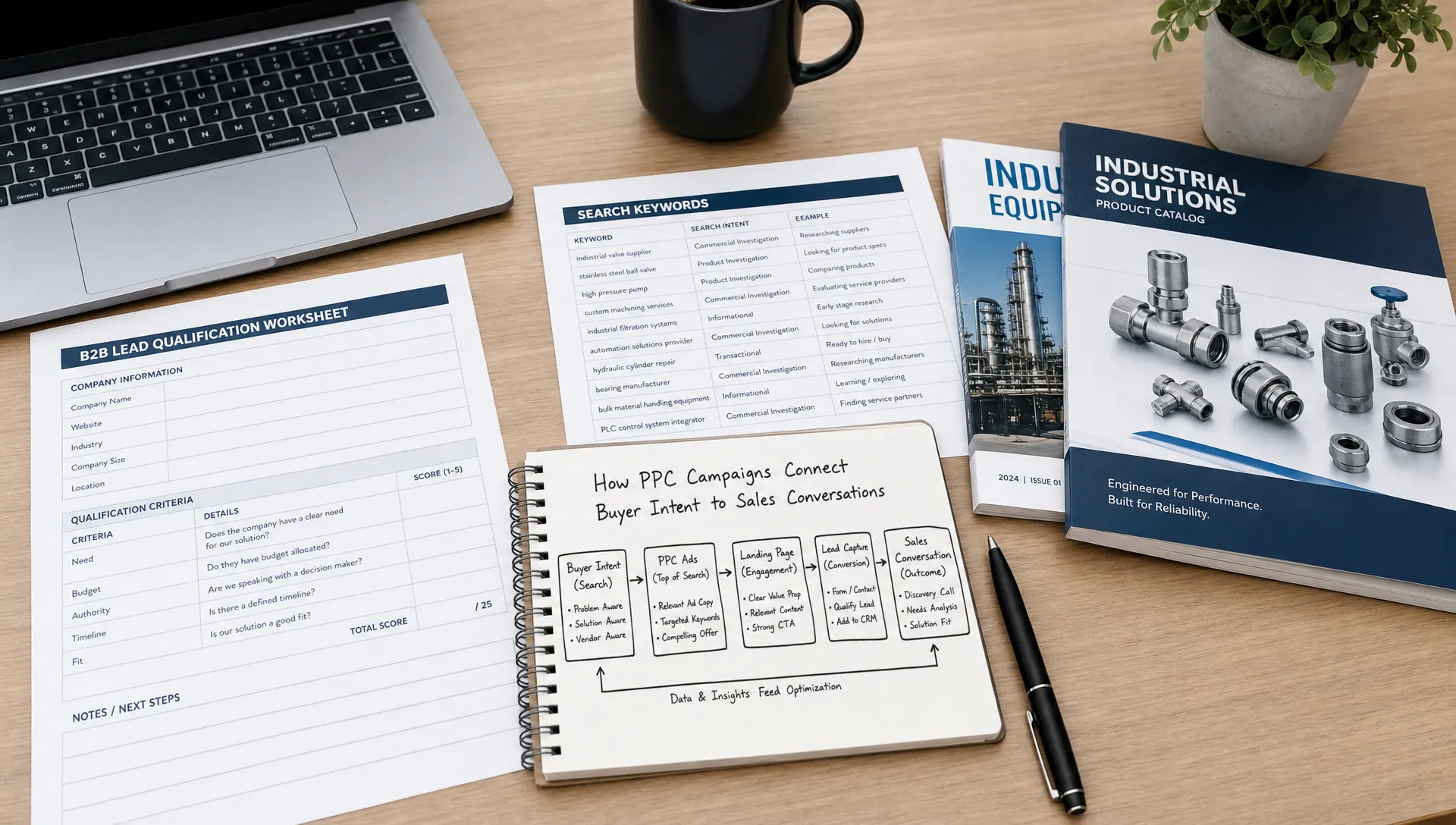
A clean desk with a B2B lead qualification worksheet, search keywords, industrial product catalogs, and a notebook showing how PPC campaigns connect buyer intent to sales conversations.

Good landing pages also reduce sales friction. They clarify who the service is for, what problems it solves, what industries are a fit, and what happens after the prospect submits a form. This is especially important in B2B because buyers may hesitate to contact a company if the next step feels vague.

If your ads are generating clicks but not inquiries, the issue may not be the campaign alone. The website may be leaking leads. The article on why your website may be losing leads covers practical conversion issues that can weaken campaign performance.

PPC Delivers Better B2B Leads When Sales Feedback Is Built In

A PPC dashboard can show clicks, cost per click, conversions, and cost per conversion. Those numbers are useful, but they do not tell the full story.

For B2B companies, the most important feedback often comes from the sales team. Were the leads real companies? Did the contact have buying influence? Was the project size appropriate? Did the inquiry match the services offered? Did the prospect have a realistic timeline?

Without that feedback loop, a campaign may optimize toward cheap conversions instead of valuable opportunities. A low cost per lead can look impressive until sales discovers that the leads are students, job seekers, consumers, or companies too small to buy.

A stronger PPC program connects marketing data with sales outcomes.

Metric What it tells you Why it matters for B2B PPC
Click-through rate Whether the ad matches search interest Helpful, but not enough by itself
Conversion rate Whether visitors take action Shows landing page effectiveness
Cost per lead What each inquiry costs Useful only if lead quality is known
Qualified lead rate How many leads meet sales criteria Better indicator of campaign quality
Opportunity value Pipeline created from PPC leads Connects spend to business impact
Close rate How many PPC leads become customers Helps determine true ROI

This is where demand generation measurement becomes important. If PPC is part of a broader growth strategy, it should be judged by lead quality and pipeline impact, not just platform-level conversions. For a broader view, see this guide on how to measure demand gen campaign results.

When PPC Can Beat SEO for B2B Lead Generation

SEO is essential for long-term organic visibility, especially in competitive B2B markets. However, PPC can deliver better leads in specific situations where speed, targeting, or search visibility matters immediately.

You are entering a new market

If your company is launching a new service, expanding into Houston, or targeting a new industrial segment, SEO may take time to build rankings. PPC can test demand quickly. You can learn which messages, keywords, and offers generate qualified conversations before investing heavily in long-term content.

You need leads faster than organic rankings can deliver

SEO compounds over time, but paid search can begin generating traffic as soon as campaigns are live. That speed matters when sales teams need pipeline support now, not six months from now.

Your organic competitors are strong

In some markets, competitors have years of SEO authority. PPC gives you a way to appear on the search results page while your organic presence grows. This can be especially useful for high-value keywords where ranking organically will require sustained effort.

Your buyers use very specific search terms

Industrial and technical buyers often search with precise terminology. PPC can target those searches directly, even if the monthly search volume is modest. In B2B, a low-volume keyword can still be profitable if one closed deal is worth thousands or tens of thousands of dollars.

You need to validate messaging

PPC is useful for testing headlines, offers, landing page copy, and calls to action. If one message consistently produces better qualified leads, that insight can inform SEO pages, sales collateral, email campaigns, and website content.

When PPC Does Not Deliver Better B2B Leads

Pay per click is not automatically a better lead source. It becomes expensive when campaigns are built around broad keywords, weak offers, poor tracking, or landing pages that do not match buyer intent.

PPC may underperform when the campaign targets too many informational keywords without a nurturing strategy. It may also struggle when the offer is unclear, the website lacks trust signals, or the sales team responds slowly to inquiries. In B2B, response speed matters because buyers often contact multiple vendors during the same research session.

Another common problem is failing to use negative keywords. If a campaign attracts searches for jobs, free resources, consumer products, or unrelated services, the budget can disappear quickly. Match types, location targeting, device performance, and search term reports all need regular review.

If your current campaign is producing clicks but not qualified opportunities, it may be time to audit where spend is going. This guide on how to fix a pay per click campaign that wastes budget explains common causes of wasted PPC spend and how to correct them.

The Best B2B PPC Campaigns Are Built Around Fit

Better B2B leads come from fit, not volume. A strong PPC campaign defines who should click and who should not.

That means your ads should not try to appeal to everyone. They should communicate the industry, service, location, or business problem clearly enough to attract qualified buyers and discourage poor-fit clicks. In many cases, specificity improves results.

For example, “Marketing Services” is broad. “B2B PPC Management for Industrial Companies” is more selective. It may receive fewer clicks, but the clicks are more likely to match the business.

The same idea applies to forms. A very short form may increase conversion volume, but it can also increase unqualified inquiries. A slightly more specific form can help filter leads by company type, project need, timeline, or budget range. The right balance depends on your sales process, but B2B companies should not judge forms by conversion rate alone.

A Practical PPC Readiness Check for B2B Companies

Before increasing PPC spend, review whether the campaign has the foundation needed to generate qualified leads. The following readiness check can help identify gaps.

Readiness question Why it matters
Do we know our ideal customer profile? PPC targeting improves when the company knows which industries, roles, and account types are a fit.
Are our keywords grouped by intent? High-intent searches should not be mixed with broad research terms without a clear strategy.
Do our ads qualify the click? Specific ad copy can reduce irrelevant traffic and improve lead quality.
Does each landing page match the search? Message match improves trust and conversion rates.
Are calls and forms tracked correctly? Without tracking, it is hard to know which campaigns create real opportunities.
Does sales report lead quality? Sales feedback helps optimize for revenue, not just form fills.
Are negative keywords reviewed regularly? Search term audits prevent budget waste from irrelevant queries.

If several answers are “no,” PPC may still work, but the campaign will likely need cleanup before it can deliver better B2B leads consistently.

Frequently Asked Questions

When does pay per click work best for B2B lead generation? Pay per click works best when buyers are already searching for a specific service, supplier, quote, or solution. It is especially effective when campaigns target high-intent keywords and send visitors to relevant landing pages.

Are PPC leads better than SEO leads? Not always. PPC can deliver faster and more targeted leads, while SEO often builds stronger long-term visibility. Many B2B companies get the best results by using PPC for immediate intent and SEO for sustained authority.

Why do some B2B PPC campaigns generate poor-quality leads? Poor lead quality usually comes from broad keywords, weak negative keyword lists, unclear landing pages, poor tracking, or optimizing for cheap conversions instead of qualified opportunities.

How should a B2B company measure PPC success? B2B companies should measure qualified lead rate, sales opportunities, pipeline value, and closed revenue in addition to clicks and cost per lead. Platform metrics are useful, but sales outcomes matter more.

Should industrial companies use PPC? Industrial companies can benefit from PPC when buyers search for specialized services, parts, suppliers, or technical solutions. The key is to target precise search terms and make the landing page highly relevant to the buyer’s need.

Turn PPC Clicks Into Better B2B Conversations

Pay per click delivers better B2B leads when it is built around buyer intent, lead quality, and sales feedback. The strongest campaigns do not chase every click. They focus on the searches most likely to become real business conversations.

For Houston-area B2B and industrial companies, a disciplined PPC strategy can support faster visibility, stronger lead flow, and better alignment between marketing and sales. If your paid search campaigns need sharper targeting, better landing pages, or a clearer inbound strategy, B2B Inbound Marketing can help you evaluate the next step.

Benefits of Social Media Marketing : inbound Marketing

Benefits of Social Media Marketing : inbound Marketing

Social media marketing refers to the process of gaining traffic or attention through social media sites. Social media itself is a catchy term for sites that may provide different social actions. For example, Twitter is a social site designed to let people share short messages or “Tweets” with others. Facebook, in contrast is a full-blown social networking site that allows for sharing updates, photos, joining events and a variety of other activities.

Social media often feeds into the unearthing of new content such as news stories. Social media can also help build links that in turn support into SEO efforts. Many people all across the globe right from Houston, Texas to India perform searches at social media sites to find social media content. Most of the top entrepreneurs consider social media marketing as the next big thing!

Here is a look at some of the ways in which social media marketing can benefit your business.

1. Increased brand appreciation
Your social media networks are just new channels for your brand’s voice and content. This is important because it simultaneously makes you easier and more accessible for new customers, and makes you more familiar and recognizable for existing customers.
2. Improved brand loyalty
Brands who engage on social media channels enjoy higher loyalty from their customers.
3. More opportunities to convert
Every blog post, image, video, or comment you share is a chance for someone to react, and every reaction could lead to a site visit, and eventually a conversion.
4. Higher conversion rates
With more opportunities to convert, conversion rates will also increase. Simply building your audience in social media can improve conversion rates on your existing traffic.
5. Higher brand influence
The more people that are talking about you on social media, the more valuable and authoritative your brand will seem to new users.
6. Increased inbound traffic
The more quality content you syndicate on social media, the more inbound traffic you’ll generate, and more traffic means more leads and more conversions.
7. Decreased marketing costs
If you can lend just one hour a day to developing your content and syndication strategy, you could start seeing the results of your efforts. This in turn will automatically reduce the marketing costs
8. Better search engine ranking
If you want to rank for a given set of keywords, having a strong social media presence could be almost obligatory. This will surely increase the search engine ranking.
In this way, your business can benefit from social media marketing and establish as a brand in the business world.

path to social media marketing

What does Google Panda update mean ?

Panda 4.0 didn’t just punish, it also rewarded sites that may have been unduly affected in previous refreshes.

We did our own in-depth research with our own resources and have noticed that majority of the sites we are optimizing weren’t affected at all by this update by Google. This is how one should prevent small businesses like you being negatively affected by Panda 4.0 or future Panda updates.

• Focus on high quality web content – Do you have redundant text content on your blog? Time to clean it up! You should not be duplicating text content throughout your website or blogs.

• Avoid web site over-optimization – It may feel nice to add a keyword to every sentence, title tag, header tag and description. But that’s not going to cut it these days. Focus on quality and useful text content and readability.

• Maintain a useable website – We mean it! Your site should be easy to navigate and fast to load. Your pages should load quickly. You shouldn’t have broken images, links, or errors on the site. Google has been saying for years that usability will affect your ability to rank.

The good news is that for those who have focused on high quality, well writtenweb and blog content while keeping their audience firmly in focus, not much appears to have changed. And with Google focusing so heavily on quality content as a rank increases, it doesn’t look like it’s going to change anytime soon.

google panda  hummingbird updates